
AI network automation for real network operations
Use AI to generate tests, compliance rules, remediation workflows, troubleshooting queries, and operational automation while keeping engineers in control.
AI should accelerate deterministic network operations, not blindly push changes into production.
What is AI network automation?
AI network automation uses artificial intelligence to assist network engineers with test creation, compliance rule generation, remediation jobs, natural language queries, troubleshooting, and eventually more autonomous network operations.
Netpicker uses AI as an assistant layer on top of structured network data, deterministic tests, controlled workflows, human approval, and automatic verification.
Most AI in networking stops at chat
A chatbot that explains commands is useful. But it does not change network operations.
Operational value starts when AI can work with structured network data, generate validation logic, create controlled workflows, and connect every action back to proof.
A practical maturity model for AI-driven NetOps
Most teams should not jump directly to autonomous networking. The useful path starts with AI assistance and grows toward controlled autonomy.
1. AI chatbot
Answers questions, explains commands, summarizes documentation, and helps engineers search faster.
2. AI assistant
Generates compliance tests, automation jobs, queries, and troubleshooting logic when prompted by an engineer.
3. Agentic NetOps
Progressively more autonomous operations based on structured data, deterministic checks, and proven workflows.
What AI already does in Netpicker
Practical AI assistance for the tasks engineers already need to do.
Generate compliance tests
Describe a check in plain English and generate Python validation logic for review.
Create remediation jobs
Turn a failed check or change request into a controlled workflow with approval and verification.
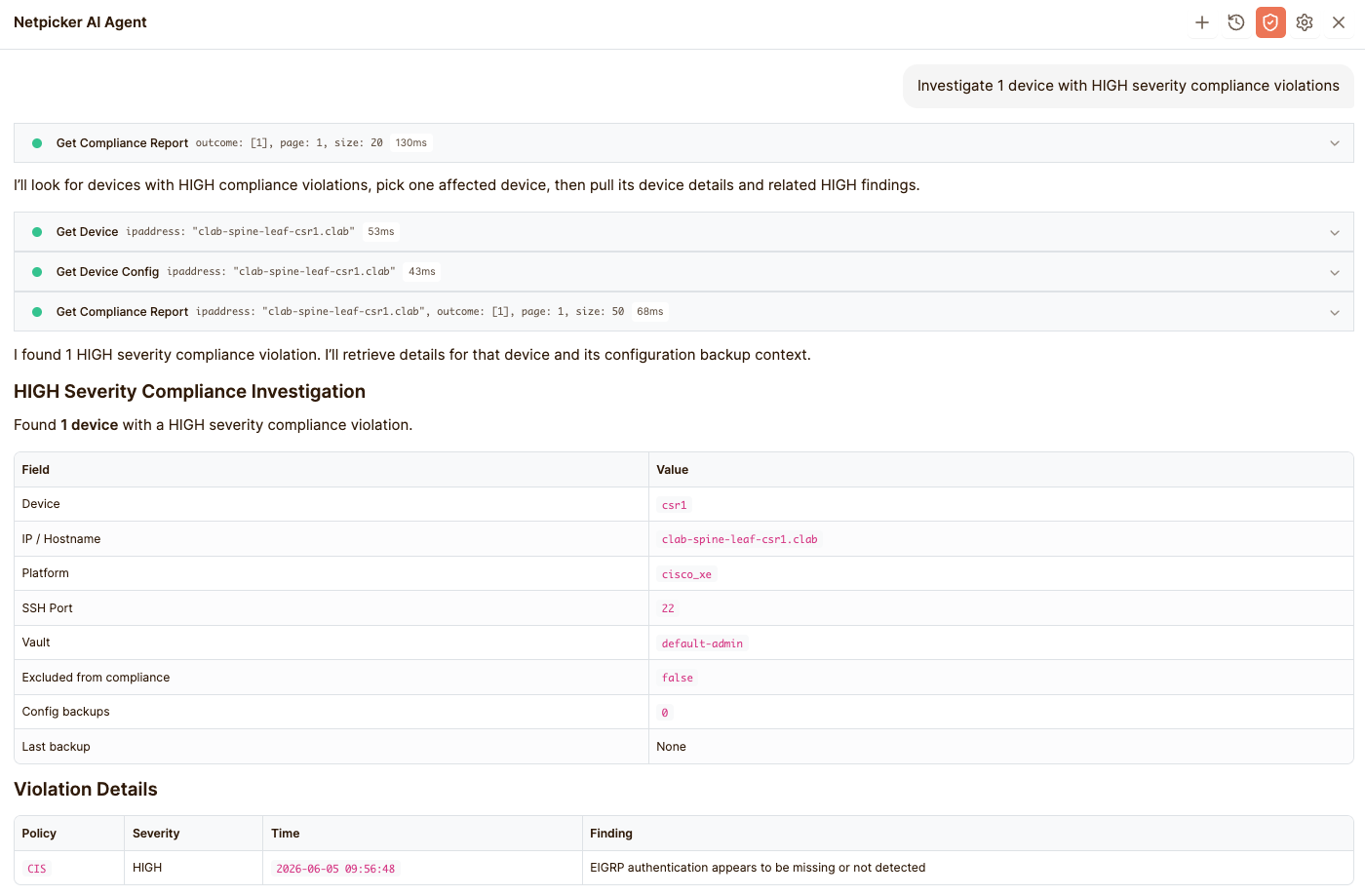
Ask your network questions
Query compliance status, CVE exposure, drift, and config changes in natural language.
Validate CVE exposure
Move beyond version matching by checking whether the vulnerable feature is actually enabled.
Analyze changes
Summarize what changed in backups, diffs, workflows, and post-check results.
Accelerate troubleshooting
Correlate structured network data, failed tests, device state, and recent changes.
Turn network intent into pass/fail tests
The engineer who knows the network should be able to create the test, even without writing Python from scratch.
Describe the compliance check, debug it against a live device, review the generated code, and deploy it across the fleet.
Fail if SSH key size is less than 2048 bits on Cisco devices
# SSH key size must be >= 2048 bits
output = device.cli("show run | include crypto key")
assert "modulus 2048" in output
Generate remediation workflows from plain English
AI network automation should not skip approval, backup, diff, or verification.
Netpicker can generate the job. The engineer reviews it, approves it, runs it safely, and the original test re-runs to confirm the issue is fixed.
Disable Telnet and enable SSH on all access switches where Telnet is enabled
pre_backup: true
approval: required
dry_run: enabled
actions: disable_telnet, enable_ssh, post_backup, rerun_test
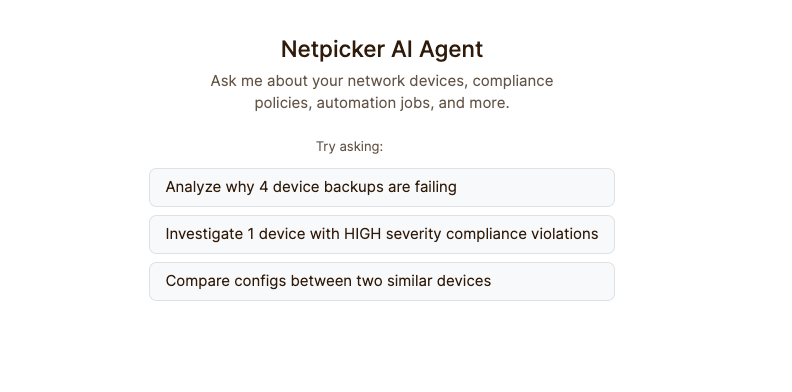
Ask your network anything
Connect AI models to live Netpicker data through APIs and MCP-style access.
Ask which devices have critical CVEs, which configs changed in the last 24 hours, which devices drifted from intent, or which policies are failing.
AI needs structured network data
AI cannot reason reliably over raw CLI output, stale spreadsheets, and disconnected tickets.
Slurp'it , Netpicker's sister product, turns network discovery and CLI output into structured device data using TextFSM parsers. Netpicker then uses that structured data for configs, backups, diffs, tests, CVE results, compliance status, workflow history, and AI-assisted operations.
Without structure
AI explains commands, summarizes text, and guesses context.
With Slurp'it + TextFSM
AI can query real device state, parsed CLI output, configs, diffs, test results, and workflow history before proposing actions.
What AI should not automate blindly
The safest AI network automation is deterministic, reviewable, and verifiable.
No blind production pushes
AI-generated jobs should require review, dry run, approval, and staged rollout.
No black-box logic
Generated tests and jobs should be readable, auditable, and owned by the engineering team.
No unchecked autonomy
Every automated action should be tied to validation, rollback strategy, and re-test evidence.
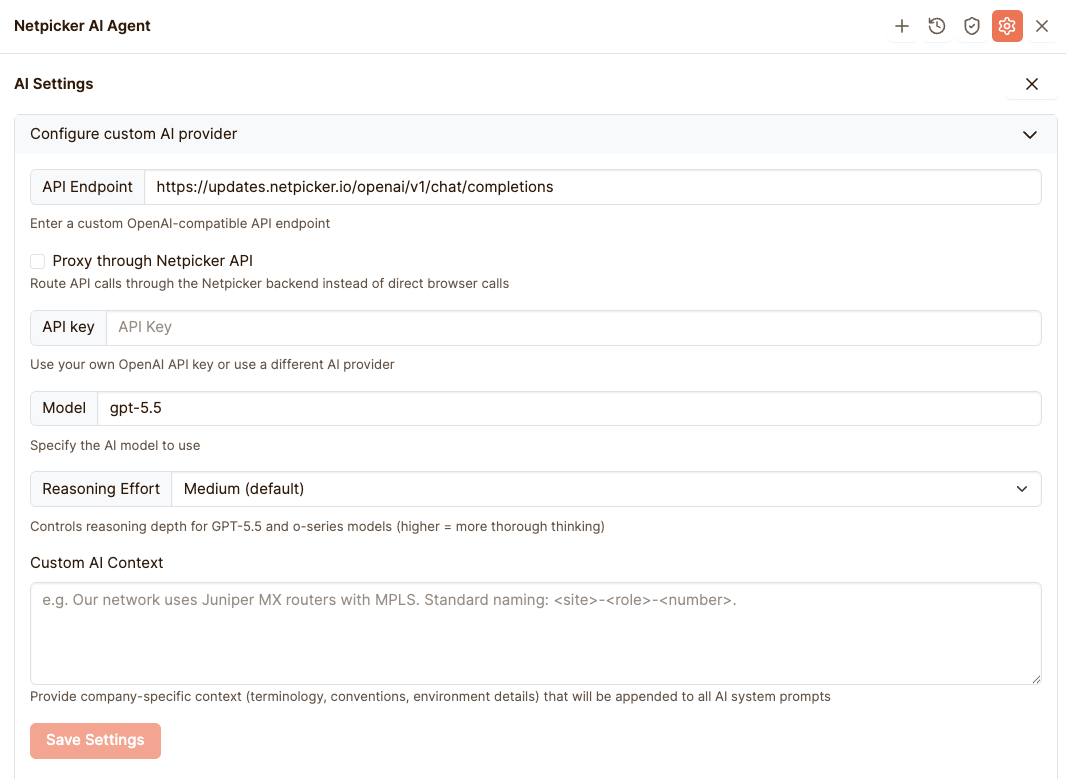
Use your own AI endpoint
AI network automation should not require sending sensitive network configurations to a shared cloud service.
Connect to your own AI endpoint, private model, local LLM, or OpenAI-compatible service. Run on-premises or air-gapped when required.
AI network automation FAQ
What is AI network automation?
AI network automation uses artificial intelligence to generate tests, create automation jobs, answer questions about network state, assist troubleshooting, and accelerate the path from manual operations to controlled automation.
What is agentic NetOps?
Agentic NetOps is the progression toward AI agents that can reason across network systems, recommend or execute actions, and provide operational summaries. In practice, most teams should first build the foundation: structured data, deterministic tests, controlled workflows, and human approval.
Can AI generate network automation scripts?
Yes. Netpicker can generate Python compliance tests and remediation jobs from plain English descriptions. Engineers review and approve the generated logic before deployment.
What is MCP for network automation?
MCP-style access connects AI models to live network data through structured APIs, so engineers can ask questions about CVEs, compliance status, drift, config changes, and failed tests in natural language.
Does AI network automation require sending data to external AI services?
No. Netpicker can connect to your own AI endpoint, private model, local LLM, or OpenAI-compatible service. Air-gapped and on-premises deployments are supported.
Should AI make network changes automatically?
Not blindly. AI-generated actions should be reviewed, approved, tested, logged, and verified. Netpicker is designed around deterministic automation with AI assistance.
Start with AI assistance. Build toward agentic NetOps.
Generate tests, workflows, and queries from plain English while keeping engineers in control of what runs.
Test. Validate. Fix.
Everything you need to build a reliable, secure and compliant network.
Config Backup
Automated backups and version control for all devices.
Network Testing
Test configurations, policies and network behavior.
Compliance Automation
Continuously validate against standards and policies.
Security Automation
Find exposure, CVEs and misconfigurations before attackers do.
Network Remediation
Automate fixes with guardrails and verification.
AI Network Automation
AI-assisted workflows for faster analysis and actions.